
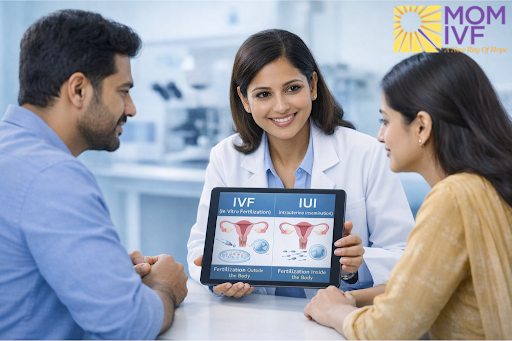
When you start exploring the path to parenthood and realize things aren’t moving as quickly as you’d hoped, the world of fertility treatments can feel like a maze of acronyms. Among the most common are IUI (Intrauterine Insemination) and IVF (In Vitro Fertilization).
While both procedures share the same goal a healthy pregnancy ,they are vastly different in terms of process, complexity, and cost. Understanding these differences is the first step in feeling empowered during your journey.
In this guide, we’ll break down everything you need to know to decide which treatment might be right for you, while also looking at why choosing the Best IVF Centre in Hyderabad can make all the difference in your experience.
What is IUI (Intrauterine Insemination)?
Often referred to as “artificial insemination,” IUI is usually the first line of treatment for many couples. It is a relatively simple, low-tech procedure that helps “good” sperm get closer to the egg.
The IUI Process:
- Ovulation Monitoring: Your doctor monitors your cycle using ultrasounds or blood tests. You might take mild oral medications (like Clomid) to encourage the growth of one or two healthy eggs.
- Sperm Preparation: On the day of the procedure, a semen sample is “washed” in the lab. This process concentrates the healthiest, most motile sperm and removes impurities that could cause uterine cramping.
- Insemination: Using a thin, flexible catheter, the doctor places the concentrated sperm directly into the uterus.
Fertilization still happens naturally inside the woman’s body. IUI simply gives the sperm a “head start” by bypassing the cervix.
What is IVF (In Vitro Fertilization)?
IVF is a more advanced and “hands-on” form of Assisted Reproductive Technology (ART). In this process, fertilization happens outside the body, in a specialized laboratory.
The IVF Process:
- Ovarian Stimulation: You take injectable medications for 8–12 days to encourage the ovaries to produce multiple eggs (ideally 10–15) instead of just one.
- Egg Retrieval: Under light sedation, a fertility specialist uses a fine needle to collect the mature eggs from the follicles.
- Laboratory Fertilization: The eggs are joined with sperm in a lab dish. In cases of male infertility, a single sperm may be injected directly into an egg (a technique called ICSI).
- Embryo Culture & Transfer: The resulting embryos are grown for 3–5 days. Finally, one or two of the healthiest embryos are transferred into the uterus.
Key takeaway: IVF bypasses the fallopian tubes entirely and allows for advanced screening, making it the “gold standard” for complex fertility issues.
IVF vs. IUI
To help you visualize the differences, here is a breakdown of the two treatments:
| Feature | IUI | IVF |
| Complexity | Simple, non-surgical office procedure | Multi-step process with minor surgery |
| Timeframe | One menstrual cycle | 4 to 6 weeks per cycle |
| Anesthesia | None required | Required for egg retrieval |
| Fertilization | Happens inside the body | Happens in a laboratory |
| Success Rate | ~10–20% per cycle | ~40–50% per cycle (age-dependent) |
| Multiple Births | Higher risk with meds (twins/triplets) | Lower risk (controlled embryo transfer) |
Which Treatment is Right for You?
The “right” choice isn’t always the most advanced one. It depends on your diagnosis, age, and history.
You might be a good candidate for IUI if:
- You have unexplained infertility.
- The male partner has mild sperm issues (low count or motility).
- There are cervical mucus problems that prevent sperm from traveling.
- You are using donor sperm.
- You are under 35 and have only been trying for a short period.
You might be a good candidate for IVF if:
- You have blocked or damaged fallopian tubes.
- There is severe male factor infertility.
- You have advanced endometriosis or PCOS.
- The female partner is over the age of 35 or 40.
- You have experienced recurrent miscarriages or genetic issues.
- Multiple IUI cycles have already failed.
Finding IVF Centers in Hyderabad
Your choice of clinic is just as important as the treatment itself. If you are navigating these options in South India, you’ll find that IVF Centers in Hyderabad are world-class, offering technologies that were once only available abroad.
When searching for the Best IVF Centre in Hyderabad, look for these specific markers:
- High Success Rates: Reputable clinics are transparent about their live birth rates per age group.
- Advanced Lab Facilities: Does the center have a state-of-the-art embryology lab? This is crucial for IVF success.
- Specialized Doctors: Experience matters. A team that includes reproductive endocrinologists and skilled embryologists can pivot your treatment plan if things don’t go as expected.
- Patient-Centric Care: Fertility treatment is an emotional rollercoaster. The best centers offer counseling and support to help you through the stress.
Hyderabad has emerged as a major hub for medical tourism in the fertility sector because it balances high-end technology with affordable care compared to Western countries.
Success Rates and Age
Age is the single most influential factor in fertility. For women under 35, IUI has a respectable success rate, and it makes sense to try 3 cycles before moving on. However, for women over 38, the success rate for IUI drops significantly (sometimes below 5%). In these cases, specialists often recommend moving directly to IVF to save precious time and preserve egg quality.
Conclusion
Deciding between IUI and IVF is a deeply personal choice, but you don’t have to make it alone. The journey usually begins with a comprehensive fertility “workup” blood tests, semen analysis, and an ultrasound.
If you are ready to start your journey, consulting with a specialist at a top-tier clinic can provide the clarity you need. Whether you start with the simplicity of IUI or the advanced science of IVF, the goal remains the same: holding your baby in your arms.
Here are 5 frequently asked questions that address the most common concerns couples have when choosing between IUI and IVF.
Frequently Asked Questions (FAQs)
1. Is IUI or IVF more painful?
Generally, IUI is compared to a Pap smear. it involves a quick, non-surgical insertion of a catheter and usually only causes mild cramping. IVF is more intensive. While the hormone injections can cause bloating or mood swings, the egg retrieval is a minor surgical procedure performed under light sedation, so you won’t feel pain during the process. Some soreness or “heaviness” in the pelvic area is common for a few days after retrieval.
2. How many IUI cycles should I try before moving to IVF?
Most fertility specialists at any Best IVF Centre in Hyderabad will recommend attempting 3 to 4 cycles of IUI. Statistics show that if IUI is going to work, it usually happens within the first few tries. If you haven’t conceived by the fourth cycle, the success rate for subsequent IUIs drops significantly, and transitioning to IVF is often the more time- and cost-effective path.
3. What is the chance of having twins or triplets with these treatments?
Surprisingly, the risk of “high-order multiples” (triplets or more) is often higher with IUI than with IVF. This is because, in a medicated IUI cycle, doctors cannot control how many eggs your body releases. In IVF, the risk is strictly controlled because the specialist usually transfers only one healthy embryo at a time (called Elective Single Embryo Transfer), which virtually eliminates the risk of triplets.
4. Can I choose IVF even if I am a candidate for IUI?
Yes. Some couples choose to go straight to IVF because they want the highest possible success rate in the shortest amount of time. This is common for couples over the age of 35 or those who have been trying for several years and want to bypass the lower success odds of IUI. Your doctor will discuss the pros and cons based on your specific health profile.
5. Why do costs vary so much between different IVF Centers in Hyderabad?
The cost of IVF isn’t just about the procedure; it’s about the technology and expertise behind it. Prices vary based on:
- Medication dosage: Older women or those with low egg reserves may need higher (and more expensive) doses of hormones.
- Lab Technology: Advanced features like ICSI, Blastocyst culture, or Laser-Assisted Hatching add to the cost but improve success.
- Infrastructure: Top-tier clinics invest in high-end air filtration systems and incubators to ensure embryos grow in the most stable environment possible.